The short answer
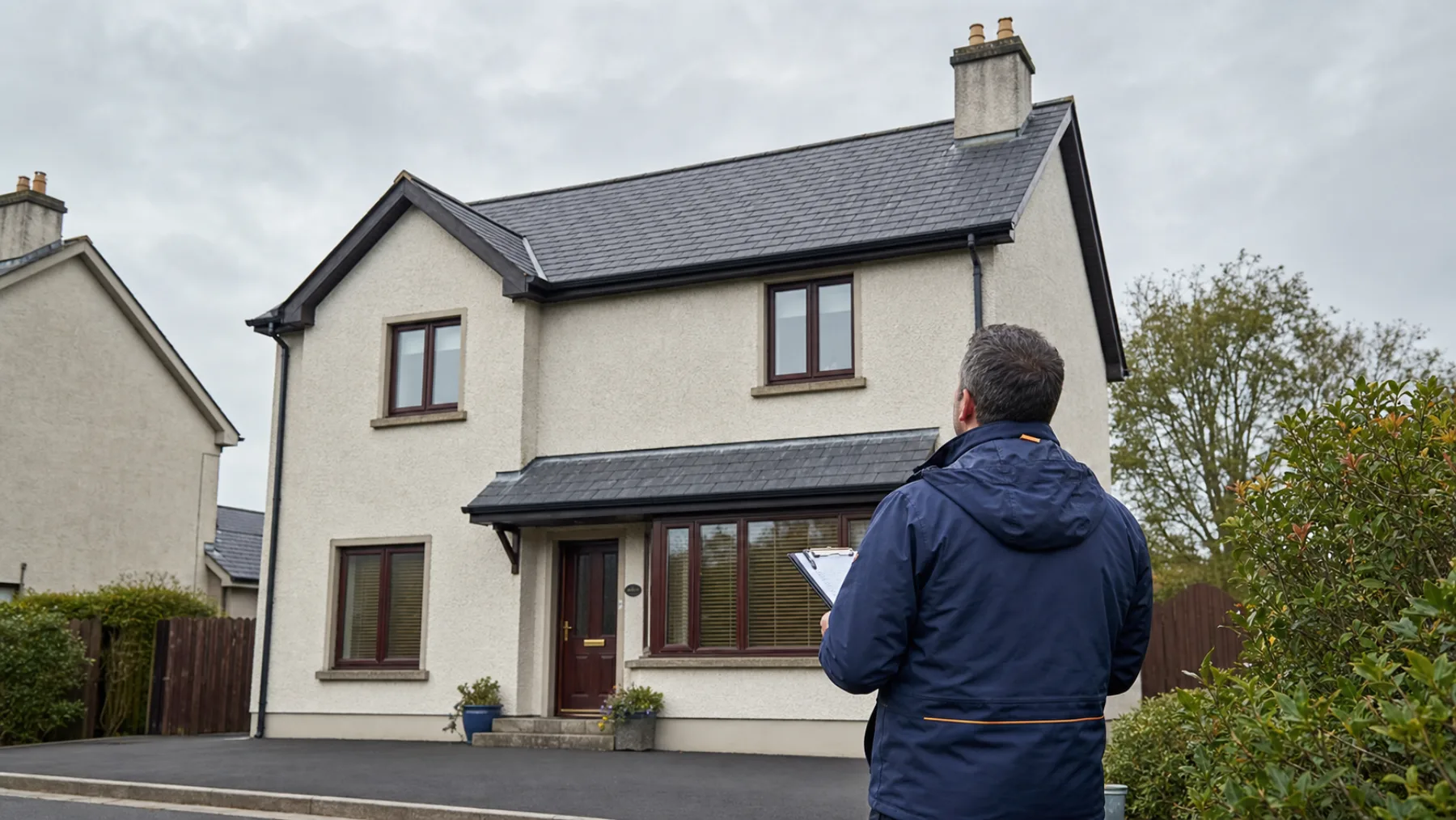
In Ireland, a straightforward accessible slate or tile repair may cost roughly €250–€650, while leak investigation and local repair commonly needs a planning allowance of €300–€900 or more. Chimney flashing, valleys, flat roofs and concealed timber damage can move the cost into four figures.
Those numbers are orientation, not a remote quotation. The same visible drip could come from one slipped slate or a failed valley that requires scaffold, stripping back and timber replacement. Location matters less than the precise scope, safe access and what is discovered beneath the covering.
Indicative roof repair prices in Ireland
| Typical work | Broad planning range | Main variables |
|---|---|---|
| Minor slate or tile repair | €250–€650 | Minimum attendance, height, access and matching older units |
| Leak tracing and local repair | €300–€900+ | How far water travelled and whether finishes must be opened |
| Chimney flashing or local leadwork | €500–€1,500+ | Chimney size, detail, scaffold and surrounding slate condition |
| Valley repair or replacement | €900–€2,500+ | Length, lining material, strip-back area and timber damage |
| Flat-roof local repair | €350–€1,200+ | Membrane type, moisture spread and whether patching is viable |
| Gutter repair or partial replacement | €180–€900+ | Height, length, fascia condition, outlet and access equipment |
| Emergency make-safe visit | Often priced separately | Out-of-hours timing, weather, travel and temporary materials |
A quote below a range is not automatically suspicious, and one above it is not automatically excessive. A local roofer may complete an accessible repair efficiently; a three-storey rear valley above a conservatory may require a scaffold design that costs more than the repair materials. Ask what the figure buys.
How to use these figures without being misled
First identify the repair category, then compare the assumptions. “Fix leak” is not a scope. “Lift slates around the west chimney, renew stepped and apron lead flashing, replace disturbed slates, include two-storey front scaffold, remove waste and provide completion photos” is.
When gathering prices, send every roofer the same basic information: property type, storeys, front and rear access, visible symptom, when it occurs, known roof material, previous work, and photographs from safe ground-level positions. Do not ask contractors to price a diagnosis you have invented. Describe the symptom and let each explain the evidence.
Separate three kinds of cost:
- Investigation: attendance, inspection, leak tracing and sometimes opening a small area.
- Access: scaffold, tower, platform or other system chosen after risk assessment.
- Repair: labour, coverings, underlay, battens, flashing, fixings, disposal and reinstatement.
This separation explains why a small material defect can still have a meaningful total. HSA guidance says work at height should be planned and carried out by competent people using suitable equipment. Safe access is part of the work, not an optional extra that a low quotation can simply ignore. See the HSA work-at-height guidance.
Nine factors that change a roof repair cost
1. Safe access and property height
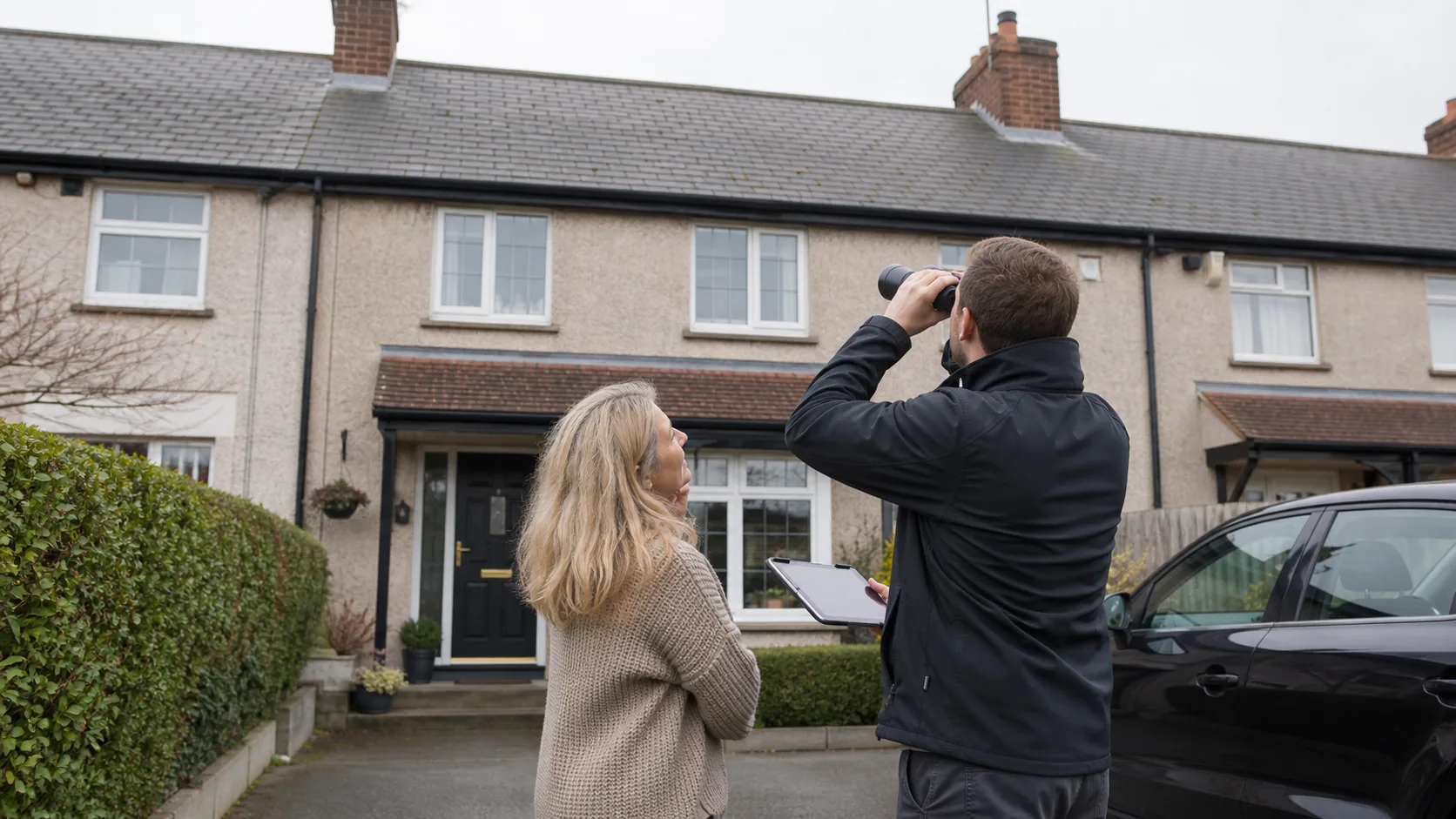
A bungalow beside a driveway differs from a three-storey terrace with a narrow lane, conservatory or public footpath below. Scaffold permits, edge protection and restricted delivery space add planning and labour but protect workers, occupants and passers-by.
2. The defect—not only the symptom
Water may enter at a chimney and appear in a bedroom metres away. A quote to replace the nearest slate may be cheap because it solves the wrong problem. Good diagnosis links an entry point, travel route and internal symptom.
3. Concealed damage
Battens, underlay, decking, rafter ends and insulation cannot always be assessed until coverings are lifted. A professional quote states what is included and how extra work will be photographed, priced and authorised before proceeding.
4. Material type and matching
Common concrete tiles may be easy to source. Natural slate, older fibre-cement formats, discontinued profiles or heritage details can require reclaimed units and more skilled labour. Leadwork is priced by detail and weight, not merely length.
5. Roof geometry
Dormers, valleys, hips, roof windows, parapets, solar panels and several chimney junctions create more interfaces where careful detailing is required. Steeper pitches also affect working methods.
6. Temporary versus permanent work
During a storm, conditions may permit only safe internal assessment or temporary weathering. Ask whether an emergency charge will be credited against permanent work and whether the temporary measure carries any limited warranty.
7. Location and logistics
Dublin labour and parking may differ from a straightforward regional job, but rural travel, exposed coastal conditions and difficult material delivery can also add cost. The site matters more than a simplistic county multiplier.
8. Ventilation and insulation interaction
Not every wet attic is a roof-covering leak. SEAI explains that indoor water vapour can condense on cold roof timbers and that ventilation must remain effective when insulation is installed. Paying to patch a sound roof will not cure condensation. Read SEAI’s ventilation guidance.
9. Business overhead and accountability
Public liability insurance, competent labour, access equipment, compliant disposal, VAT where applicable, written documentation and returning if a warranted defect occurs all have a cost. A high price does not prove competence, but a sustainable price should cover professional delivery.
How to compare roofing quotes line by line
Put each quotation beside the same checklist. If an item is absent, mark it “unknown” rather than assuming it is included:
- exact roof area and diagnosed defect;
- proposed method, extent of strip-back and named materials;
- access equipment, protection of paths and responsibility for permits;
- labour, VAT status, delivery, waste removal and making good;
- allowance or approval process for concealed damage;
- start window, estimated duration and bad-weather procedure;
- deposit and stage-payment amounts;
- workmanship guarantee and separate manufacturer warranties;
- before, during and after photographs.
Suppose Quote A is €900 and says “repair chimney,” while Quote B is €1,350 and includes scaffold, replacement lead soakers and stepped flashing, ten matching slates, waste and VAT. The totals cannot be compared until Quote A answers those same points. The lower number may become higher once exclusions appear—or it may represent a smaller repair based on a different diagnosis.
Ask for proof of insurance relevant to roofing work and enough business detail to identify who is contracting with you. The HSA’s guidance for homeowners commissioning construction recommends making a reasonable assessment of contractor competence.

Repair or replace: when is the larger job justified?
Repair is normally proportionate where the failure is isolated and the surrounding covering, fixings, underlay and structure remain serviceable. One storm-damaged section does not automatically condemn an entire roof.
Replacement deserves investigation when slates or tiles fail across several elevations, fixings are broadly deteriorated, underlay and battens are at the end of their useful condition, the deck is wet over a wide area, or repeated local repairs continue without controlling water. A reroof can also be the right moment to coordinate insulation and ventilation—but the design must preserve moisture control.
Ask for repair and replacement as separate written options where both are credible. Each should state expected scope and limitations, not an unsupported lifespan promise. For an expensive decision or conflicting diagnoses, consider an independent building surveyor before choosing the contractor who benefits from the larger sale.
Remember that insurance and maintenance are different questions. The CCPC notes that buildings insurance commonly covers certain sudden events such as storms subject to the policy, but generally excludes wear and tear. Confirm with your insurer rather than treating a roofing quote as a coverage decision. See the CCPC home-insurance guide.
Roofing price and sales red flags
- Instant certainty without inspection. Photos can support triage, but complex leaks rarely reveal their full route through one ceiling mark.
- A major replacement offered after an unsolicited doorstep visit. Get an independent assessment and time to compare.
- A vague total. If the repair area, method and materials are missing, there is no reliable basis for comparison.
- Pressure for cash or a disproportionate deposit. Material deposits can be reasonable, but milestones should be written and linked to work.
- Access is never discussed. That raises questions about both safety and later extras.
- Every defect is solved with coating or sealant. Surface products have legitimate uses, but they do not replace failed flashing, rotten decking or correct water-shedding details.
- An unlimited-sounding guarantee. Ask what is covered, exclusions, duration, claims process and the legal entity standing behind it.
Frequently asked questions
How much should replacing one roof slate cost?
The slate itself may be inexpensive, but the total includes attendance, diagnosis, matching, safe access and labour. For an accessible local repair, €250–€650 is a more realistic planning frame than multiplying a shop price by one. Complex height or scaffold can take it beyond that range.
Do roofers charge for quotations?
Practices vary. A visual quote may be free, while formal leak investigation, drone work, opening-up or a written survey can be chargeable. Ask what the visit includes and whether the fee is credited if you proceed.
How many roofing quotes should I get?
For non-emergency work, two or three comparable written quotes usually expose scope differences. In an active leak, authorise only necessary safe mitigation first if there is no time to compare, then obtain written options for permanent work.
Should I pay a roofing deposit?
A proportionate deposit may fund ordered materials or booked scaffold. Avoid unexplained large advance payments. Record the amount, purpose, cancellation terms and stage payments in writing, and use a traceable payment method.
Is VAT included in roof repair prices?
Never assume. Ask whether the contractor is VAT-registered, whether the figure includes VAT, and request the appropriate invoice. The estimates on this page are broad consumer planning figures, not tax calculations.
Can a roofer price accurately from photographs?
Photos can identify the roof type and help plan attendance, but they may not reveal access constraints, water routes or concealed deterioration. Treat a photo-based figure as provisional unless the scope and assumptions are explicit.
Sources and editorial method
The price ranges are broad Get Roofers editorial planning estimates, presented transparently rather than attributed to a government tariff that does not exist. Safety, homeowner and moisture-control sections were reviewed against guidance from the Health and Safety Authority, Competition and Consumer Protection Commission, and Sustainable Energy Authority of Ireland. Obtain a written inspection-based quotation for your property.
Get a property-specific roof quote
Describe the issue and compare a written quotation from a roofing specialist serving your area.
Request a roof repair quote →